
Course Structure
Training is delivered through Oxford’s Doctoral Training Centre, with students registered at one of the three participating universities and working with supervisory teams across the wider ILESLA partnership. You begin with shared training, work on a team challenge, undertake two rotation projects and develop the proposal that will become the basis of your substantive DPhil or PhD project.
You get room to explore before you specialise, and the structure and support to turn that exploration into a confident doctoral direction.
Core and advanced training
You begin with induction and core training at the Doctoral Training Centre. This introduces the programme, the research themes, the partner organisations and doctoral expectations.
Training is individually tailored and benefits from collaboration between the different training programmes in the DTC. Students join ILESLA from a wide range of backgrounds across the biological, environmental, mathematical, physical and computational sciences, and related areas. The first year is designed to help you strengthen your skills, including the skills needed to succeed in doctoral research, such as project management, scientific writing, presentation and communication skills, and an understanding of open science, ethics, research integrity and responsible research, including trusted research and innovation.
Core and advanced training also includes areas such as programming, software engineering and sustainable research practice; mathematics, statistics, data science and AI; molecules, cells and systems biology; environmental systems and numerical methods; bioinformatics, structural biology, microscopy and other advanced methods
Team challenge
You will take part in a 4 week team challenge to consolidate the skills developed through the initial training modules.
The team challenge gives you a different kind of research experience. It asks “what can we build, solve or explore together?” You will work with other students to scope a challenge set by one of our non-academic partners, share tasks, manage the work and present the results.
Projects may involve data analysis, software development, communication or other challenges that benefit from a team approach. They provide a practical introduction to the way much modern science is done.
Rotation projects
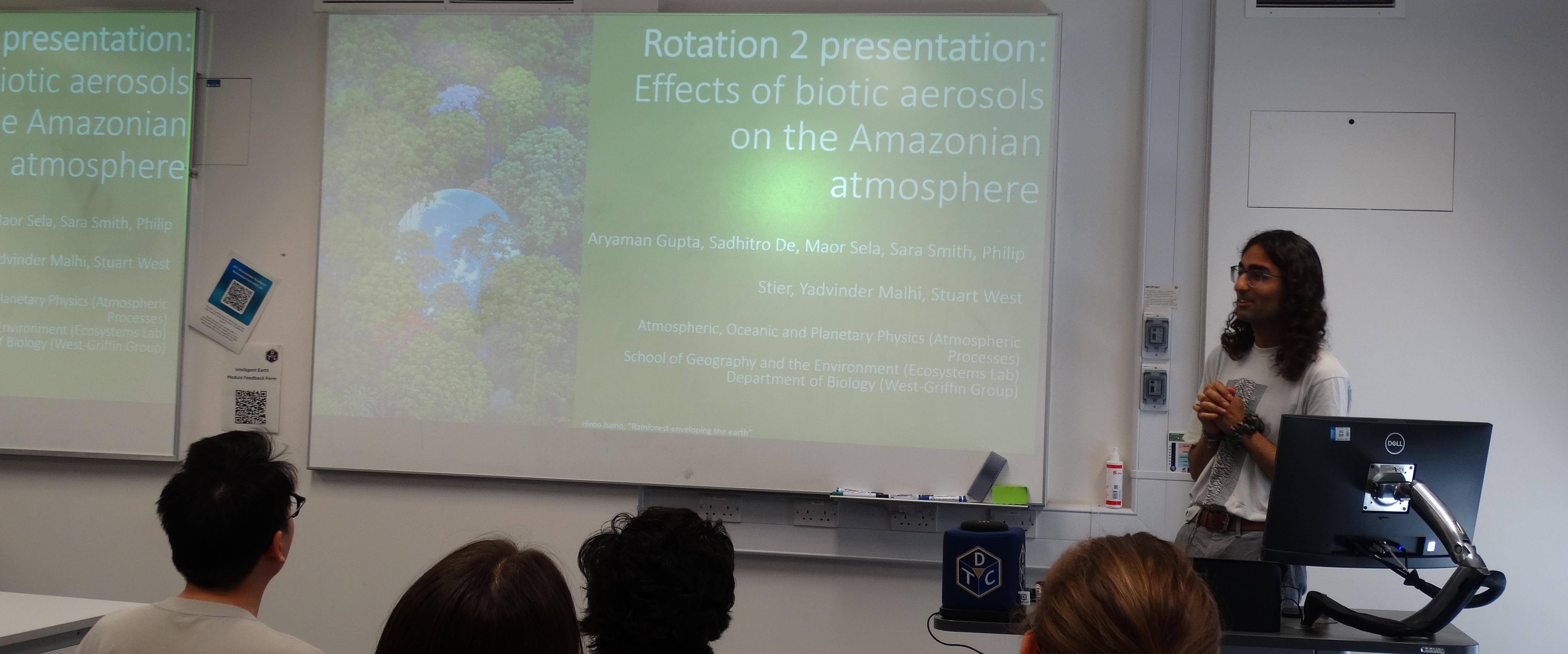
Two 10-week rotation projects will give you the chance to step into a different research environment, explore ideas, work with potential supervisors and try out topics and approaches you may not have explored before.
Rotation projects and the subsequent doctoral projects are offered by researchers across the ILESLA partnership. Some are linked to Open-IIC or collaborative partners. They will help you make an informed decision about your substantive doctoral project and supervisory team.
You will receive information on potential projects and eligible supervisors during induction. You will also have opportunities to meet supervisors and research groups during the first term before selecting your rotations.
Developing your doctoral project
ILESLA students do not apply to undertake a specific doctoral project. During the first year, your training, rotations and team project will help you refine your research direction. By the end of the first year, you will be clear: which research environment, supervisory team and project direction should form the basis of your doctoral research project.
Your doctoral project builds on the foundations established during the first year. It may develop directly from one or both of your rotations, or it may be a new project shaped by what you learn during the year.
Your project may be based at Oxford, Oxford Brookes, The Open University or one of the wider hosting partners (The Pirbright Institute, Diamond Light Source, ISIS Neutron and Muon Source), depending on your admitting institution, supervisory team and project alignment. You remain registered at your admitting university throughout the programme, and a member of your supervisory team must be based at that university.
In some cases you will have a co-supervisor who is employed by an Open-IIC or collaborative partner. This could include organisations that are not yet part of Open-IIC and ILESLA, subject to approval by the programme.
We also support students and supervisors who are working on commercially relevant projects, or projects that have the potential to lead to broader impacts, in obtaining the mentorship and training needed to realise the impact of their research. This can include the development of spin-outs, IP and social ventures; providing scientific advice to policymakers, and engagement with communities, partners, end-users, decision-makers and rights holders.
The final project must fit the ILESLA remit and have an appropriate supervisory team, training plan and research environment.
Continuing training and professional development
During the research phase, you remain connected to the wider ILESLA and DTC community through skills training, cohort activities, symposia, peer networks and professional development.
You will continue to access career and skills development sessions, research seminars, advanced training, symposia and wider opportunities through ILESLA, the DTC and the participating institutions. This may include scientific writing, presentation skills, public engagement, research integrity, project management, entrepreneurship, teaching preparation, data management, coding and discipline-specific training.
The Career Development Skills programme runs throughout the four years and covers research ethics, scientific methodology, public engagement, scientific writing, poster production, publishing, communication, management, interview techniques and career development.
Placements and internships
All ILESLA students undertake a 12-week internship or placement with a non-academic partner organisation to help develop your ability to move confidently between academic and non-academic worlds.
This is a chance to apply your skills in a different setting. Depending on your interests, that might mean industry, policy, conservation, public engagement, innovation, entrepreneurship, data science, facilities-based research or the public and third sectors.
Students working with an industrial or non-academic partner for their doctoral project normally undertake their placement with that partner organisation. Other students may use the placement to explore a different professional context or to build experience connected to the broader impact of their research.